
An Olympian, a toaster and the future of the grid
A century ago, engineers made electricity so easy we forgot it was there. Now heat pumps, batteries and half-hourly tariffs have dragged the wiring back into the living room. Craig Lewis, who watched the corporate network solve the same problem, says the answer is to hide it again.
Robert Förstemann has the most famous thighs in track cycling. They are, by any measure, absurd: reportedly some 74 centimetres around, thicker than many grown men’s waists, and capable of hauling a bicycle past 40 miles an hour. Some years ago a film crew hooked the German Olympic medallist up to a domestic toaster and asked him to make breakfast.
The toaster needed about 700 watts. Förstemann gave it everything. By the end he was slumped over the handlebars, wrecked. The bread was barely brown.
An engineer I spoke to this week set me the clip as homework. He uses it in his teaching, and the point is not about cycling. It is about how thoroughly the people who built Britain’s grid in the 1920s did their job. They made it so easy to flick a switch that we have forgotten what comes out of the wall. An Olympian’s best effort arrives silently, on demand, for a few pence. They hid the wiring.
For a hundred years that worked. It is now coming undone.
The wiring is back
Walk into a newly electrified home and the wiring is everywhere again, only now it is made of software. There is a heat pump in the garden, or storage heaters in the hall, and a battery in the cupboard. There may be solar on the roof and a car on the drive. The tariff changes every half hour. The grid would quite like you not to boil the kettle at ten past five.
Each device comes from a different manufacturer, with its own app, its own cloud and its own private notion of what “smart” means. None was designed to talk to the others. The householder, who wanted only a warm room and a bill they could afford, has become the systems integrator.
I have seen this film before.
A problem already solved
Before co-founding LDS, I spent my career in corporate technology, much of it on the networks of a very large industrial company. Fifteen years ago those networks had exactly this problem.
Every branch office needed a link back to headquarters. The dependable kind, a private circuit known in the trade as MPLS, was excellent and ruinously expensive. The cheap kind, ordinary broadband or a 4G dongle, was plentiful and flaky. Each came from a different carrier on a different contract. Network managers spent their working lives choosing between overpaying and hoping.
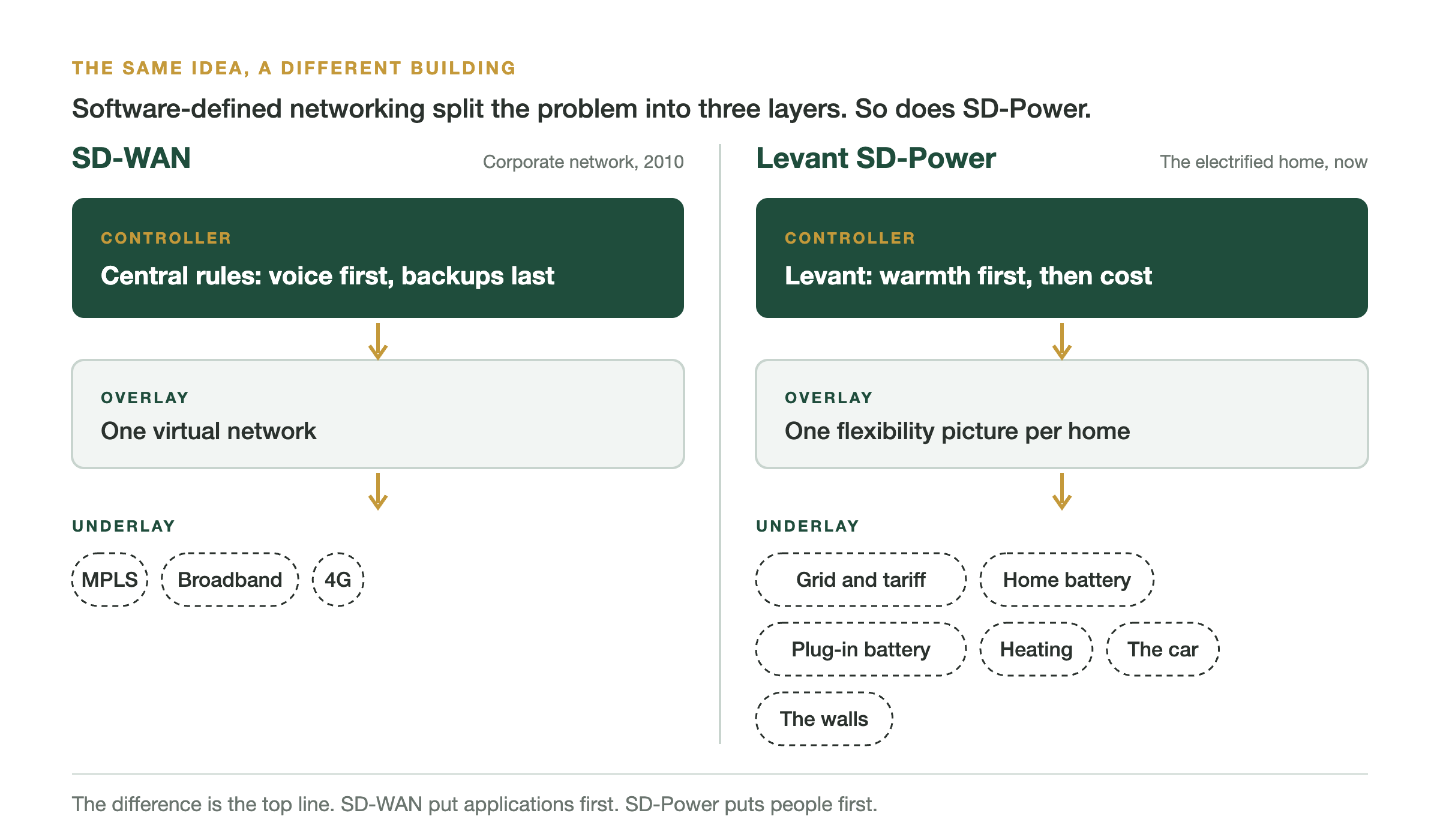
Then came software-defined networking, sold as SD-WAN, and the economics changed almost overnight. Nobody laid a new cable. What changed was the thinking about the cables already in the ground.
SD-WAN split the network in two. Underneath sat the real, physical links, good and bad, whoever supplied them: the underlay. On top sat a single virtual network that hid which link any given conversation was using: the overlay. Above both sat a controller, a central brain holding the company’s rules, testing every path every few seconds and steering each kind of traffic accordingly.
Voice calls went down the clean path, because a stuttering call is useless. Backups went down the cheap one, because nobody minds if a backup takes ten minutes longer. When a link failed, traffic moved before anyone noticed.
SD-WAN did not make the cheap links better. It made a collection of imperfect ones behave like something you could rely on.
The broadband stayed exactly as flaky as before. SD-WAN made a pile of imperfect links behave, together, like one dependable network. Nobody in the branch office needed to understand how. They picked up the phone and it worked.
A branch office with a boiler cupboard
Look at the modern home through that lens and the likeness is uncomfortable. The grid, the battery, the solar and the car are its links, each of a different quality and price at different times of day. The heating, or whatever else draws the most power, is the demanding application that must never drop. It is the branch office of 2010, with a boiler cupboard.
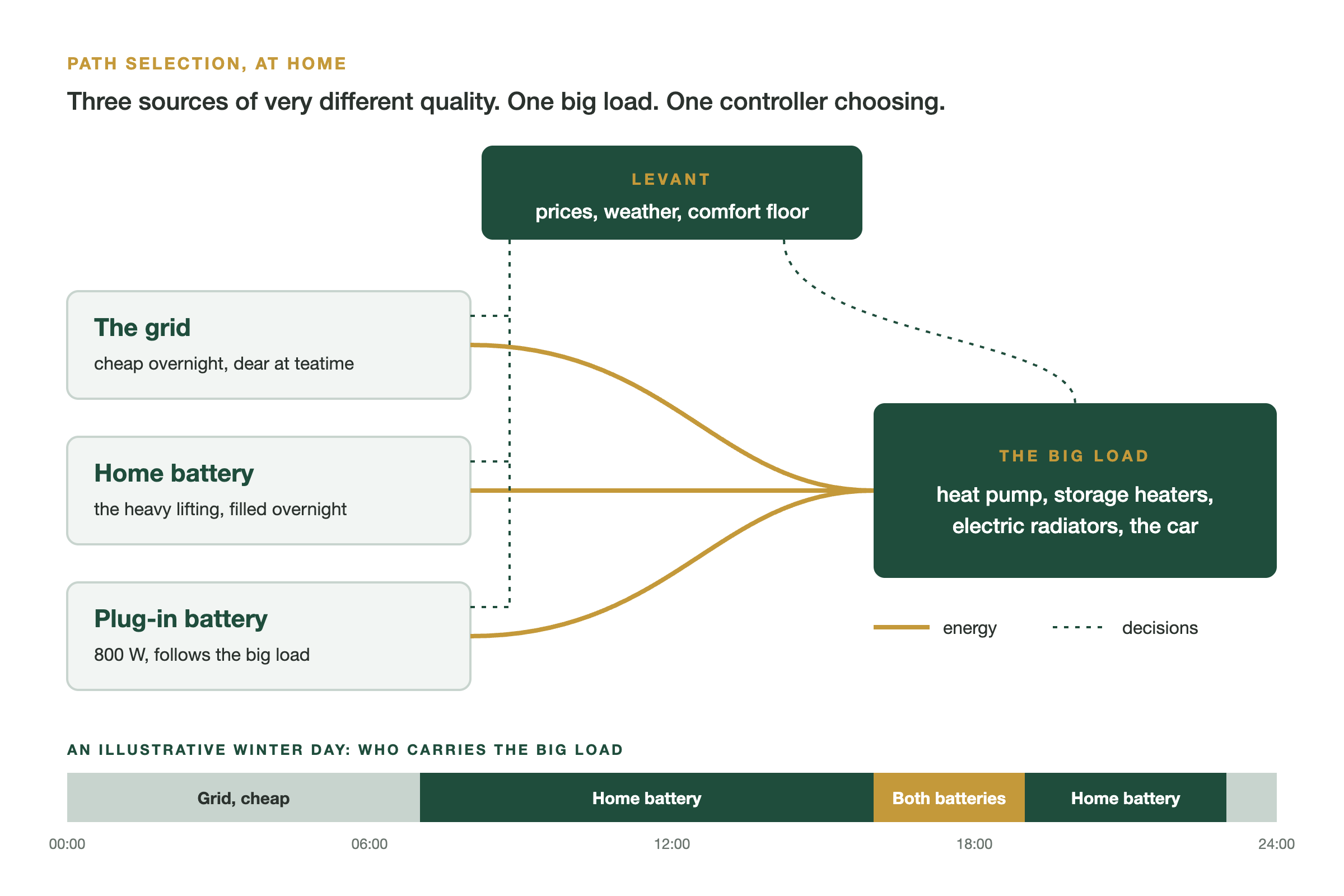
At LDS we have spent months living inside this problem on our test bed, a real, occupied home with an air-to-water heat pump, a GivEnergy battery, a small EcoFlow battery, solar panels and a cheap overnight tariff. It is deliberately awkward, because the real world is.
The heat pump is a case in point. The survey that sized it called for about 6.5 kilowatts. Measured, the house needs closer to 3.5. On a mild, damp November day the unit has far more muscle than the job requires, so it fires up, overshoots, cuts out and starts again, losing efficiency every time. To a network engineer it is a badly provisioned circuit. Ripping it out is not an option, so the software above it has to compensate.
That is what we have been teaching it to do. The EcoFlow, capped at 800 watts, now follows the heat pump through its software interface. When the heat pump runs while the grid is expensive, the small battery quietly carries part of the load. When power is cheap, it refills. The big battery does the heavy lifting overnight. Nobody in the house touches a thing.
A network engineer would call it path selection: three links of very different quality, one demanding application, and a controller deciding, minute by minute, which should carry the load.
The heat pump happens to be the test bed’s big load. In another home it will be night storage heaters, oil-filled radiators, an immersion heater or a car on the drive. The controller does not much care which. It sees a large load that has to be served, and a set of links that can serve it.
Levant SD-Power
We are calling the idea, for now, Levant™ SD-Power.
Levant is the platform LDS has built to read homes through their smart meters: how a house heats and cools, when someone is under-heating, where an energy adviser’s time is best spent. SD-Power gives it hands. The physical home, from the meter and tariff to the heating, whatever form it takes, and the thermal mass of its walls, which is the cheapest battery most houses will ever own, becomes the underlay. Each home’s flexibility, how much demand can move, when, and at what cost to comfort, becomes the overlay, described the same way whoever made the kit. Levant becomes the controller, deciding once, in one place, and then either instructing devices directly or handing the decision to a licensed flexibility provider to carry out.
The rest of the SD-WAN toolkit translates almost word for word. Onboarding a home becomes a consent and a meter connection rather than an engineer’s visit. Failover becomes what happens when a device drops offline, or when the grid calls for help on a freezing evening. And the measure of success is not latency or packet loss but what each unit of warmth actually costs the household, a figure we call the commercial coefficient of performance.
Where the analogy breaks
There is one point at which the comparison fails, and it is the most important one.
SD-WAN put applications first. SD-Power has to put people first.
In a home, the equivalent of the voice call is warmth for somebody who cannot afford to be cold: an 88-year-old living alone, a family with a newborn, a man recovering from a hip operation. Their comfort is not traffic to be steered around the network. It is the guarantee the whole network exists to keep.
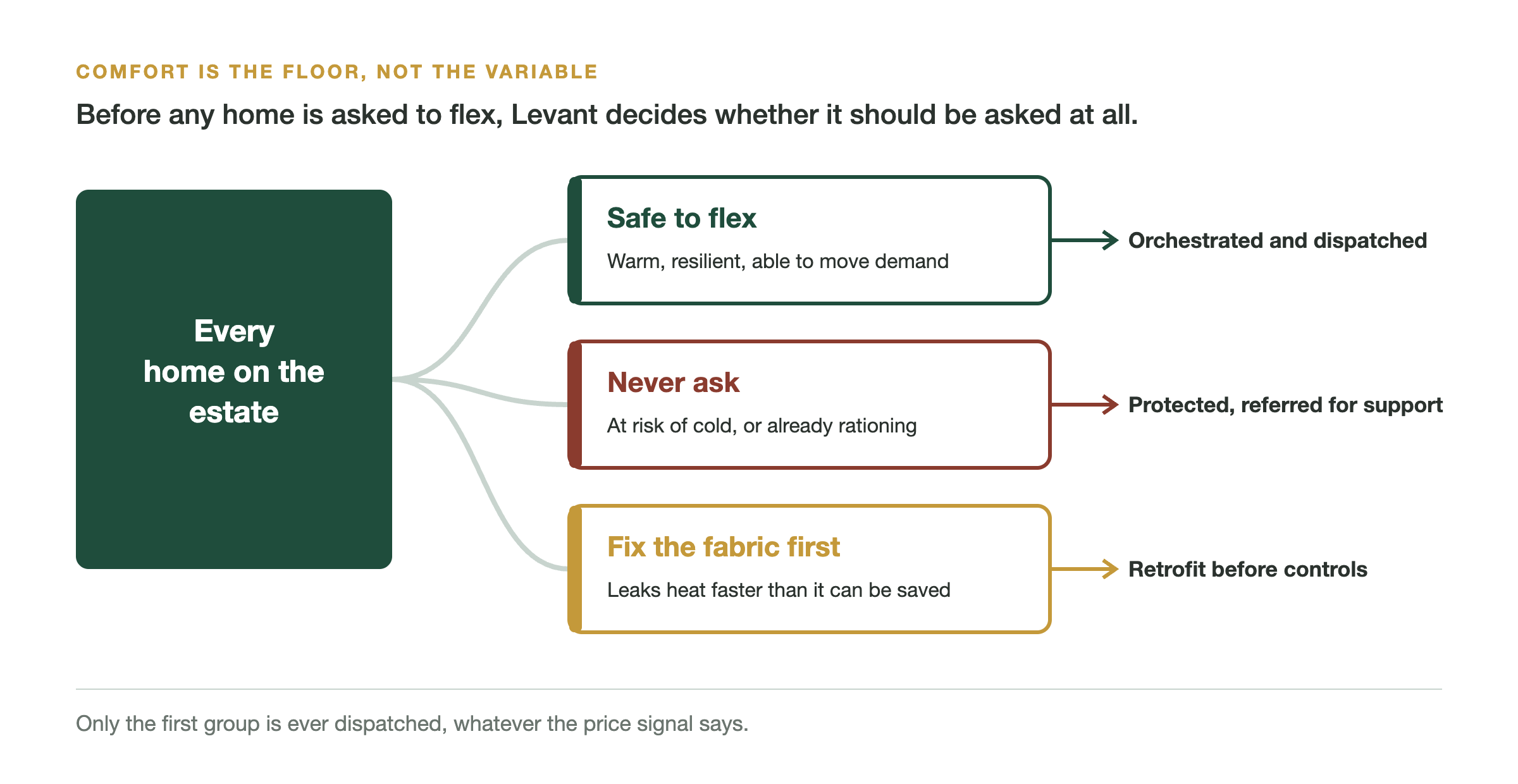
A cold home is never the flexibility. Comfort is the floor, not the variable.
That sounds obvious. Yet a good deal of what is sold as flexibility today treats comfort as the thing being traded: turn the heating down for an hour, collect a few pounds. For a comfortable household that is a fair bargain. For one already rationing its heating, it can do real harm, and the people most tempted by a small payment are precisely those least able to bear the cold that comes with it.
So in SD-Power the welfare picture comes first. Levant already sorts homes into three groups: those that can safely offer flexibility, those that should never be asked, and those where the honest answer is to fix the fabric of the building before touching the controls. If a home cannot keep its occupant warm, it is not dispatched, whatever the price signal says.
Who else is on the line?
There is an obvious question, and anyone who has worked in corporate IT will already be asking it. If one controller can turn heating, batteries and car chargers up and down across thousands of homes, what happens when the wrong person gets hold of it?
It is the right question. A home that can be switched remotely is a home that can be switched maliciously, and a few thousand homes switched at the same moment stop being a domestic matter and become a problem for the grid.
Here, too, the network world got there first. SD-WAN did not only make cheap links behave. It made them safe, by wrapping every conversation in an encrypted tunnel before it touched the public internet. The branch office’s traffic crossed the same broadband as everybody else’s, but nobody else could read it, join it or impersonate it.
SD-Power borrows the same trick, using a modern tunnelling technology called WireGuard. It is small, a few thousand lines of code against the hundreds of thousands in older systems, which makes it unusually easy to audit, and it now ships inside the Linux kernel itself. Each device in the home is given its own cryptographic key. It talks to Levant down its own tunnel and to nothing else. Nothing in the house sits open to the internet waiting to be found, one home cannot see its neighbour, and a device without the right key simply does not exist as far as the overlay is concerned.
Two more rules matter as much as the encryption. The comfort floor lives in the home as well as in the controller, so if the tunnel drops or something upstream misbehaves, the heating falls back to keeping the occupant warm rather than to whatever it was last told. And no single instruction can move every home at once: changes are staggered and capped, so that even a mistake cannot become a stampede.
None of this is exotic. It is what any competent network team would insist on for a branch office. Homes deserve at least as much.
If it makes no sense, it is probably regulatory
The same engineer had another line that has stayed with me: “If it makes no sense at all, it’s probably regulatory.”
He described two new-build estates near where he lives. Building regulations required solar, so every roof carries three panels. Not one house has a battery. On a sunny afternoon the power spills out of the estate into a local network that does not want it. The network operator cannot put a battery beside the substation to soak it up, because the moment it discharged it would count as a generator. In engineering, social and economic terms, it is mad.
No single home will fix that. But a thousand homes whose batteries, hot water cylinders and walls are orchestrated together look, to the local network, like a very large and very polite battery that nobody had to build. That is the promise of consumer-led flexibility, and it holds only if the people inside those homes are properly looked after.
The rules are shifting, if slowly. Since the end of August, plug-in solar panels have been legal in Great Britain, up to 800 watts. Plug-in batteries are not yet covered, though in Germany millions already sit in living rooms, and electrons do not behave differently on the far side of the North Sea. The kit will keep coming, in more brands and more shapes. Someone has to make it work for the household rather than for the manufacturer.
Hide the wiring
Which brings us back to the toaster.
When I explain this work, I tend to reach for the anti-lock brakes in a car. Almost no driver understands the algorithm, and none needs to. They know only that when they stamp on the middle pedal, the car stops in a straight line. They trust it because it works, and because it was designed around them rather than around the brake.
That is the standard. The household should never need to know what a kilowatt hour is, which battery is discharging, or why the heating paused for twenty minutes. They should notice a warmer home and a smaller bill. The adviser supporting them should see, plainly, who is safe, who is at risk and why. And the grid should find a dependable resource it can call upon without anyone shivering for it.
The engineers of the 1920s hid the wiring by making supply enormous, central and utterly reliable. Their successors will have to hide it differently: by persuading millions of small, mismatched, cleverer homes to behave, together, like something you can depend on.
We managed it once for the corporate network. We can manage it again for warmth.
Craig Lewis is a technologist working in domestic energy and a co-founder of LDS Consultancy. Levant SD-Power is a working name for the next stage of Levant development.
Levant™ is a UK registered trade mark of LDS Consulting Limited, No. UK00004413246.
Sources
- Robert Förstemann and the 700 W toaster: Stickybottle; Sports Illustrated.
- Plug-in solar in Great Britain from 27 August 2026, 800 W output cap, plug-in batteries excluded for now: Fuse Energy; Which?