
The number your heat pump doesn’t tell you
Every heat pump comes with an efficiency figure. None comes with a measure of what its heat actually costs. C-COP puts the two together, and shows how the same machine can beat gas or cost more to run, depending only on when it operates.

Ask anyone with a heat pump how it is doing and you will get a number. Three point two. Three point five. Four, on a good day.
It is the coefficient of performance, the units of heat the pump delivers for every unit of electricity it consumes, and it has become the badge of a good installation.
The LDS test bed, an occupied family home we have instrumented down to almost every room, has a year of measured data behind its number: 3.2.
Over the summer, electricity at the capped rate cost about three and a half times as much as gas. Three and a half against 3.2 is roughly breakeven, once the efficiency of the gas boiler is accounted for.
On those numbers alone, the heat pump and the gas boiler it replaced come out level.
That is true.
It is also only one part of the day.
Same machine, same house, same week. It can deliver heat for a fraction of the cost of gas, or cost more than gas would have charged. Nothing about the hardware changes.
What changes is when it runs and what electricity costs at that moment.
No conventional COP certificate or heat-loss survey tells you that.
So we developed a metric that does.
We call it C-COP.
C-COP in one breath
COP tells you how efficiently a heat pump turns electricity into heat.
C-COP tells you how cheaply that heat is delivered, measured against the gas boiler it replaces.
C-COP = COP × (Cost of heat from gas ÷ Electricity price per kWh)
At the October 2026 energy price cap:
- Gas costs 7.97p/kWh.
- A gas boiler operating at 90% efficiency produces useful heat at 8.86p/kWh.
- That 8.86p becomes the reference against which electricity-powered heating is measured.
A C-COP of 1.0 means heat costs the same as gas.
Above 1.0, you are beating gas. Below 1.0, you are paying more.
It turns a physical performance figure into a relative measure of economic performance. And it can be calculated for every half hour of every day.
Take the test bed's annual COP of 3.2.
At the summer price cap, with electricity at 26.11p and gas at 7.33p, its C-COP was approximately 1.00.
On 1 October, the cap changed. Gas rose by 8.7%, while the electricity unit rate increased by less than 1%.
The same heat pump, at the same COP, moved to a C-COP of 1.08.
Nobody touched it. Nothing got more efficient.
The market moved around it.
The full method, including how stored heat, solar and batteries are accounted for, is set out in the C-COP technical methodology, version 1.0, which is available from LDS on request. It is open for review and not yet independently validated.
The ladder
The LDS test bed runs on Intelligent Octopus Go, paying 6.6p per kWh overnight between 11:30pm and 5:30am, and 35.61p during the remaining hours.
Here is what those prices do to the economics of producing heat.
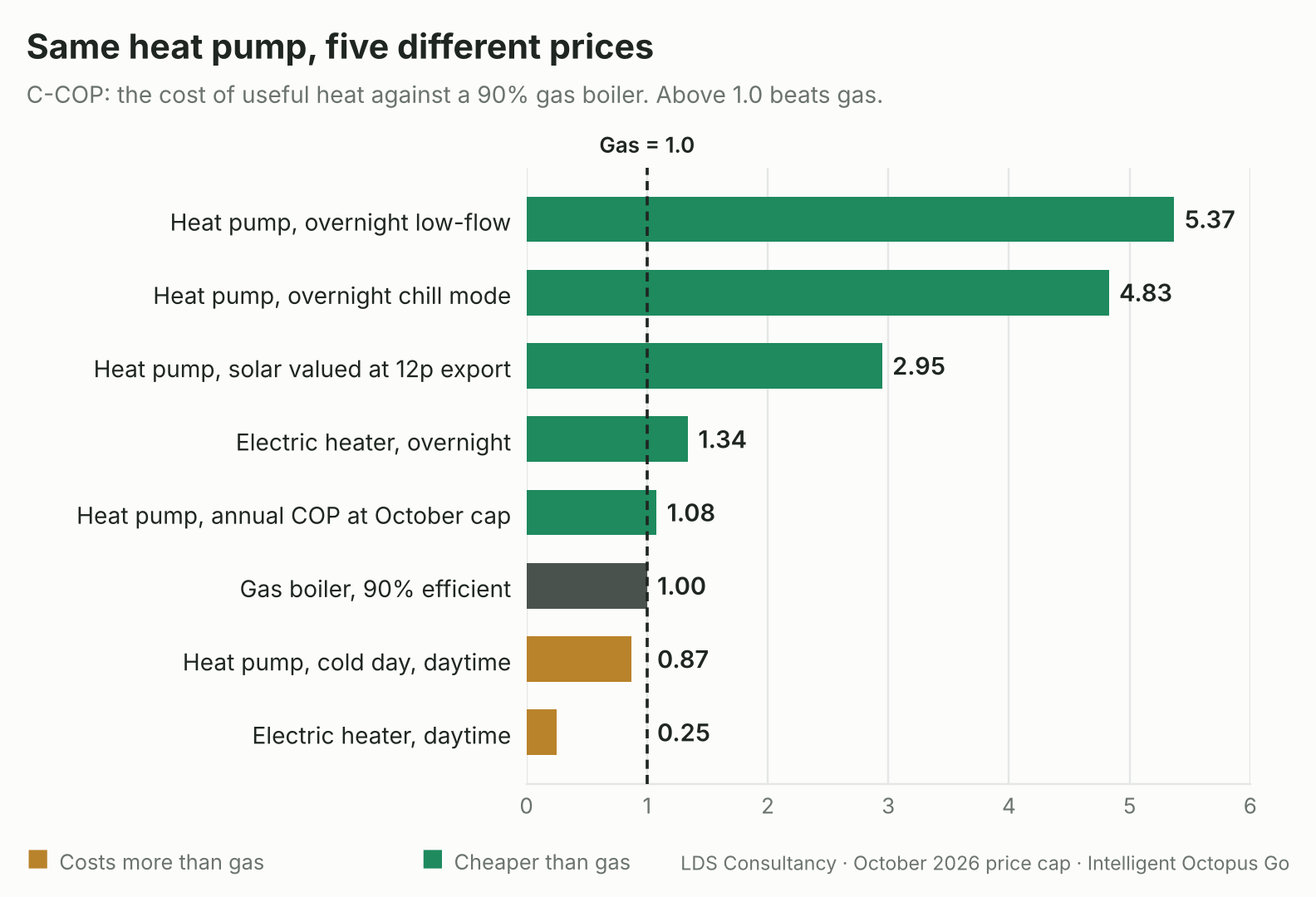
Calculations use the October 2026 gas reference of 8.86p per kWh of useful heat. The figures describe operating conditions and illustrative performance, not eight independent installations.
Look at the electric heater overnight.
The least efficient common way of turning electricity into heat beats a modern gas boiler, simply because it runs at the right hour.
Then look at the heat pump.
It appears five times in the comparison, from 0.87 to 5.37. It is the same type of technology in each case.
COP reflects the performance of the heating system under its operating conditions.
C-COP adds the price of electricity and the timing of its consumption.
And those are variables that software can influence.
Inside the test bed
The LDS test bed has a 6kW air source heat pump, temperature sensors in almost every room, two home batteries, rooftop solar, an electric car on the drive and a year of half-hourly energy data.
It is where we experiment before asking anyone else to live with the results.
Our baseline is what we call chill mode.
The heat pump does most of its work during the cheap overnight hours, brings the house up to temperature, and then allows it to coast through more expensive periods using heat stored in the building's walls, floors and furnishings.
Its overnight C-COP approaches 5.
Lower the flow temperature and the heat pump can become more efficient still.
Last night, during the cheap hours, the system reported a COP of 4.0 and delivered an estimated 3.3kWh of heat for approximately 6p.
That works out at less than 2p per kWh of heat, against 8.86p from gas.
We treat that measurement with appropriate caution. The heat pump's own estimate of thermal output can read high at low flow temperatures, and cooler water takes longer to warm a room.
It only counts if the rooms actually reach the temperature they need.
Then there is a smaller trick.
When the compressor stops, the radiators still contain hot water. Leave the circulation pump running for a few minutes and it can move approximately 0.3kWh of residual heat into the rooms using just 20Wh of additional electricity.
That is not a true COP of 15, because the heat was generated and paid for earlier.
But recovering useful residual heat with minimal additional consumption is exactly the kind of decision that intelligent control software can make.
And it is the sort of opportunity that conventional thermostats often miss.
Solar has a price too
Electricity from your own solar panels feels free.
It isn't.
Every unit you use is a unit you cannot export, so its economic value includes whatever it could have earned instead.
On a flat 12p export tariff, a heat pump operating at COP 4 produces a C-COP of 2.95.
On Agile Outgoing, export might be worth only 8p or 9p at a sunny midday. Under those conditions, consuming the solar electricity for heating can look considerably more attractive.
But what if you could store that electricity and sell it during the evening peak?
Then the calculation changes.
Store it and sell it at 25p, and after a 90% battery round trip each unit is worth about 22.5p. Against that, the same heat pump scores 1.57.
At 35p, the stored unit is worth about 31.5p, and the heat pump scores 1.12: only just ahead of gas.
Export limits and the battery's spare capacity matter too. If the energy cannot be stored or exported, that evening price was never really on offer.
For a solar-powered home, therefore, the question is never simply whether to use electricity or export it.
It is whether to use it now, store it, or sell it later.
The answer can change every half hour.
Batteries: the same principle, a different measure
A battery makes no heat.
It purchases or stores electricity at one moment and supplies or sells it at another.
There is no gas boiler to compare against, so conventional heat C-COP does not apply. But the underlying idea of comparing the economic value delivered against the cost incurred is equally useful.
For storage, we can define a simple battery value ratio:
Battery value ratio = (Discharge value × Round-trip efficiency) ÷ Charging cost
Assuming 90% round-trip efficiency:
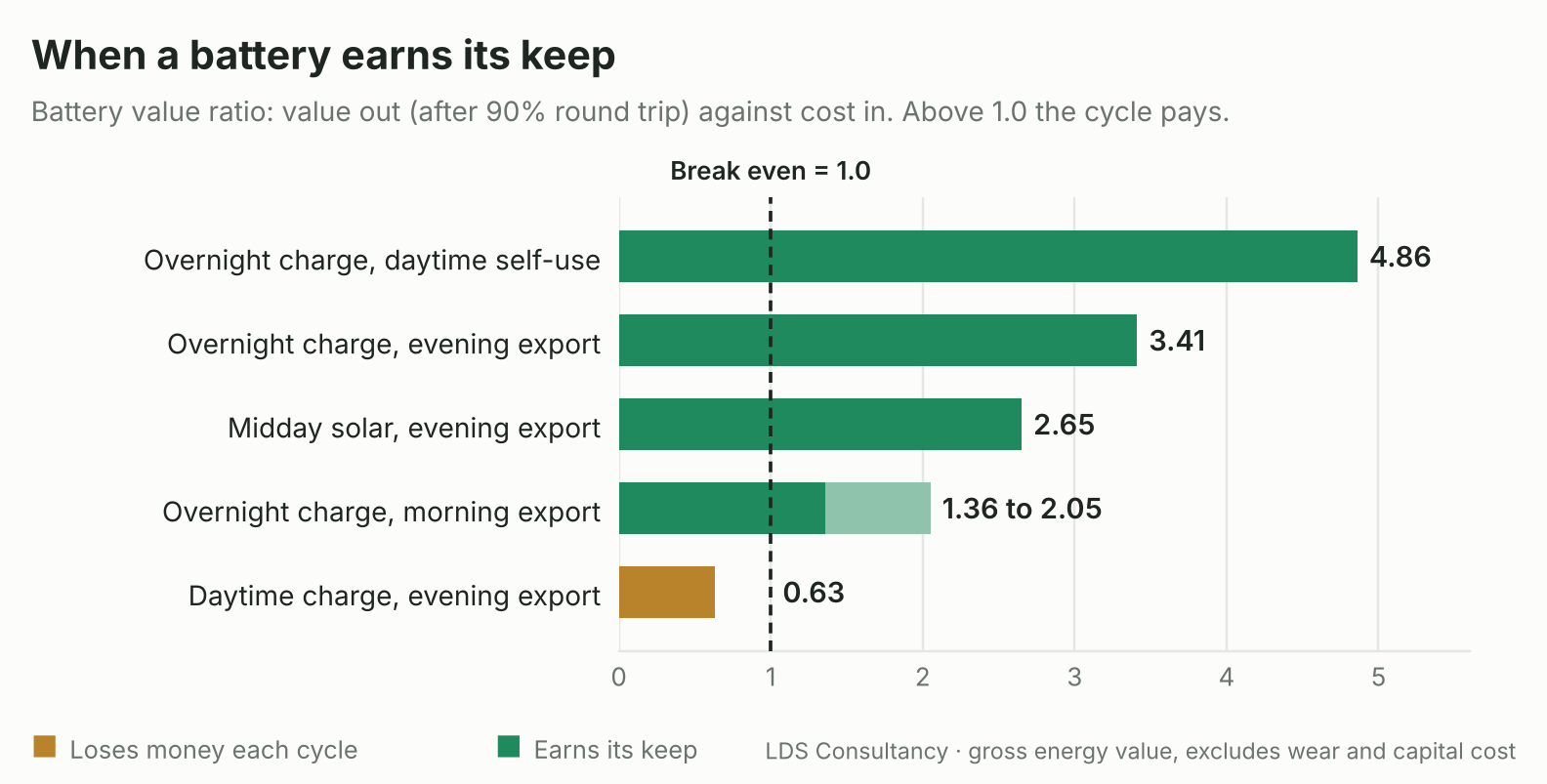
These are gross energy-value ratios, not financial investment returns. They exclude battery wear, standing charges, export restrictions and capital expenditure.
The LDS test bed predominantly operates around the first two scenarios.
Its 13.4kWh of battery storage charges overnight, supports household demand during expensive periods and can export surplus energy when prices justify it.
Across a year, just 1% of its imported grid electricity was consumed between 4pm and 7pm.
To the grid at teatime, the house has almost disappeared.
Yet there is an important distinction between a profitable battery cycle and a worthwhile battery investment.
We modelled a 10kWh battery operating against Octopus Agile using a year of real half-hourly consumption data from fifteen households.
With day-ahead scheduling, the median household saved approximately £200 per year under the assumptions used.
Against installed costs of £350 to £700 per kWh, the economics did not support a ten-year payback for most households in the sample.
The biggest users came closest.
How much electricity a home consumed mattered more than exactly when it consumed it.
That is not a contradiction.
A battery can execute an excellent energy trade and still be an expensive asset to own.
Storage has its strongest case where demand is substantial, where heating and transport are electrified, and where it can also provide value to the electricity system.
The car on the drive
The same economic argument applies to electric vehicles.
For a car, the reference is not gas heating but the petrol it replaces.
At approximately 174.6p per litre and 45 miles per imperial gallon, petrol costs around 17.6p per mile.
An electric car achieving 3.3 miles per kWh has a very different cost depending on where and when it charges.
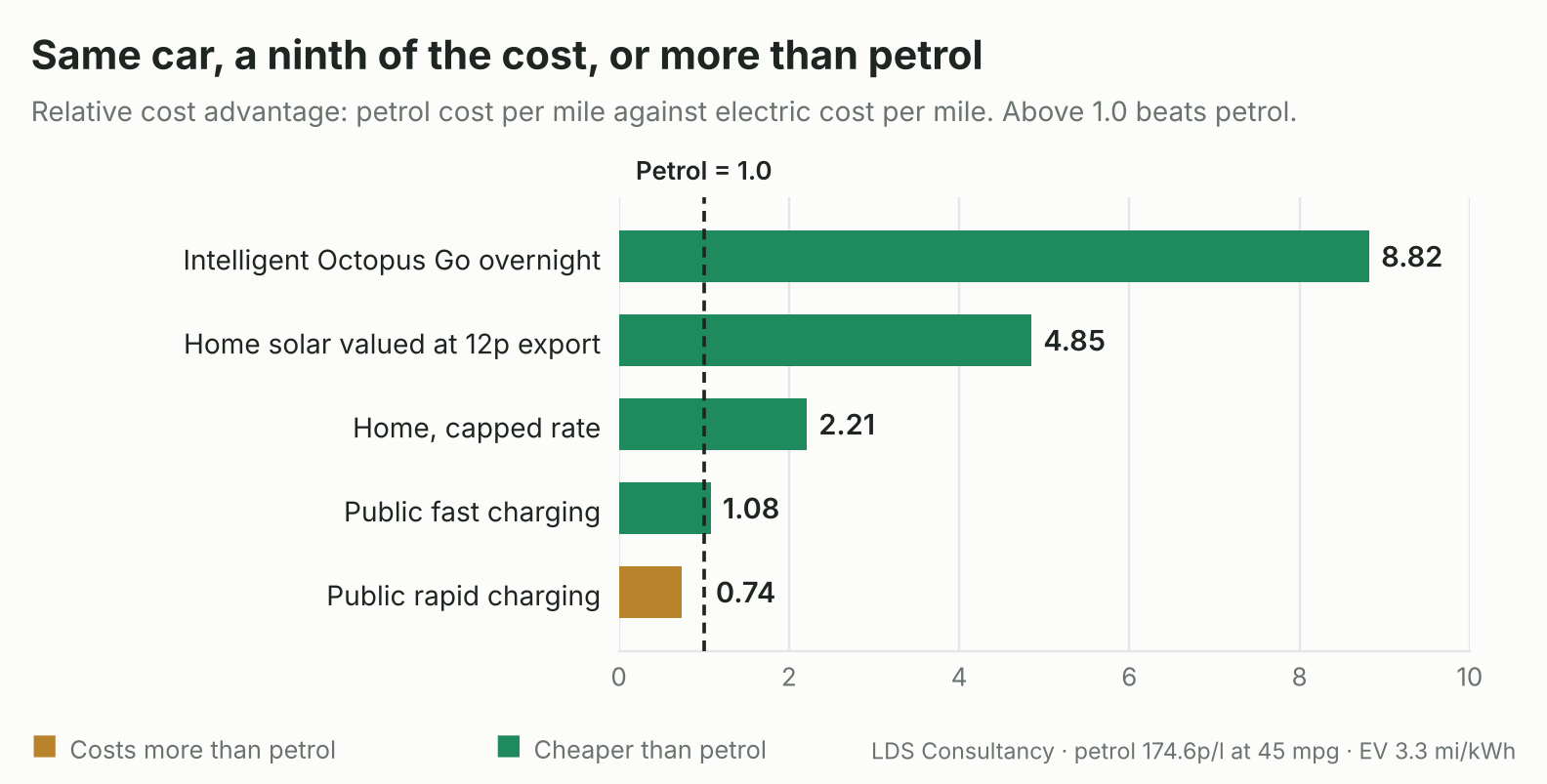
The relative cost advantage compares petrol cost per mile against electric cost per mile. It is conceptually similar to C-COP but is not a thermal coefficient of performance.
This helps explain why arguments about whether electric cars are cheaper to run so often end in disagreement.
A driver relying on rapid charging can pay more per mile than an equivalent petrol car.
A driver charging at home overnight can pay roughly one-ninth as much.
Same car. Same battery. Same motor.
A vastly different economic result, determined by the charging price.
Right on the edge
Some of the most interesting cases sit close to the breakeven line.
Consider a household on Intelligent Octopus Go with a gas boiler and a hot water cylinder fitted with an immersion heater.
Which should heat the water?
Conventional wisdom says the immersion heater is the expensive option. Its COP is exactly 1.0, while the gas boiler is generally cheaper to operate.
On a flat electricity tariff, that remains true.
But at 6.6p overnight, the immersion heater achieves a C-COP of 1.34.
At 7.6p, a rate Octopus has quoted for newer customers, it still achieves 1.17.
The immersion heater beats gas on marginal energy cost.
Not necessarily by a fortune, but enough to challenge the assumption that resistance heating must always be more expensive.
The result also depends on cylinder losses, boiler efficiency and whether the immersion heating remains within the cheap window.
Allow it to run at the capped daytime electricity rate and the economics reverse.
The same heater can be the cheaper or dearer way to produce hot water.
The clock decides which.
Why the grid cares
Electricity is often expensive between four and seven in the evening for a reason.
It is when the country comes home, cooks, washes and switches on, just as solar generation falls away.
The network and generation resources needed to meet those concentrated peaks are expensive, and their costs ultimately affect everybody.
Overnight can be cheaper because demand is lower and renewable generation may be plentiful.
At times of exceptional wind generation and low demand, wholesale-linked tariffs can even turn negative.
The price is a signal.
C-COP provides one way of measuring how a heating system responds to it.
Shift useful heat production towards cheap electricity periods, without compromising comfort, and both the household and the electricity system can benefit.
That is what the industry calls demand flexibility.
It is also becoming a national priority.
The National Energy System Operator's Demand Flexibility Service now operates year-round.
By mid-June 2026, more than 11.3 million smart meters had migrated to half-hourly settlement arrangements.
The Government's Clean Flexibility Roadmap supports a £74 million consumer-led flexibility challenge, targeting at least 2GW of flexibility by 2030.
That is roughly the capacity of a large power station, potentially assembled from thousands of smaller decisions made by heat pumps, batteries, vehicles and businesses.
But none of that happens simply because households read government policy.
It happens when the technology makes the right decision at the right half hour, automatically.
The timing is the job
Businesses face the same opportunity.
Octopus Energy's Shape Shifters Trio tariff provides three fixed daily pricing periods:
- A cheaper night rate from midnight until 7am.
- A discounted day rate from 7am until 4pm and again from 7pm until midnight.
- A higher peak rate between 4pm and 7pm.
Shift heating, hot water production or EV charging away from those three peak hours and the cost of useful energy can fall without changing the equipment.
Shape Shifters Agile goes further, with electricity prices varying every half hour.
That creates additional opportunities but also makes manual decision-making impractical for most small businesses.
For a school, the message is straightforward.
Don't buy a better heat pump. Make the one you've got smarter.
Controls that understand occupancy, room temperatures, electricity prices and the thermal characteristics of a building can choose when and how to deliver heat.
C-COP then provides a way to measure the economic outcome against the gas that building might otherwise have consumed.
The Committee on Fuel Poverty's 2026 annual report recognises the importance of automation in making time-of-use tariffs accessible to vulnerable households.
That distinction matters.
A pensioner on a prepayment meter should not have to become an electricity trader to benefit from a smarter energy system.
The technology should do the work.
That is what we are building at LDS.
Our Levant platform brings together energy consumption, prices, generation forecasts and building conditions to make energy performance understandable and increasingly actionable.
C-COP is one part of that approach: a way to understand not merely how efficiently energy is converted, but how economically the required outcome is delivered.
Cost is not comfort
There is one important warning.
Any single performance number can be gamed.
C-COP measures the relative cost of useful heat. It does not establish whether a building is warm enough.
A system that scores brilliantly by leaving the kitchen cold at teatime has not succeeded.
It has found a cheaper way to fail.
That is why C-COP must be considered alongside three additional measures:
- Comfort: Did occupied rooms reach the required temperatures?
- Timing: Was useful heat available when it was needed, not merely when electricity was cheapest?
- Energy balance: Were stored heat, thermal losses and previously purchased electricity accounted for correctly?
Over a heating season, C-COP must be calculated from total useful heat and total electricity cost, not by taking a simple arithmetic average of individual half-hourly scores.
Averaging can flatter performance.
And flattery is exactly what this metric is intended to get past.
What you do with it
For twenty years, much of the conversation about heating has focused on how efficient the equipment is.
That remains an important question.
It is no longer enough.
The better question is how economically the required outcome can be delivered, and whether changing when and how the system operates could improve it.
The objective is not the highest COP at any cost.
It is the right amount of heat, in the right place, at the right time, for the lowest practical cost.
Do that across millions of homes, schools and businesses, and you have also created something the electricity grid needs: controllable, intelligent flexibility.
COP is what you buy. C-COP is what you do with it.
Next time: the same principle applied to something with nothing to do with heat pumps, and everything to do with what it costs to hand a piece of work to an AI agent.