
The Race to Zero: my electricity cost £38 last year. The car's included.
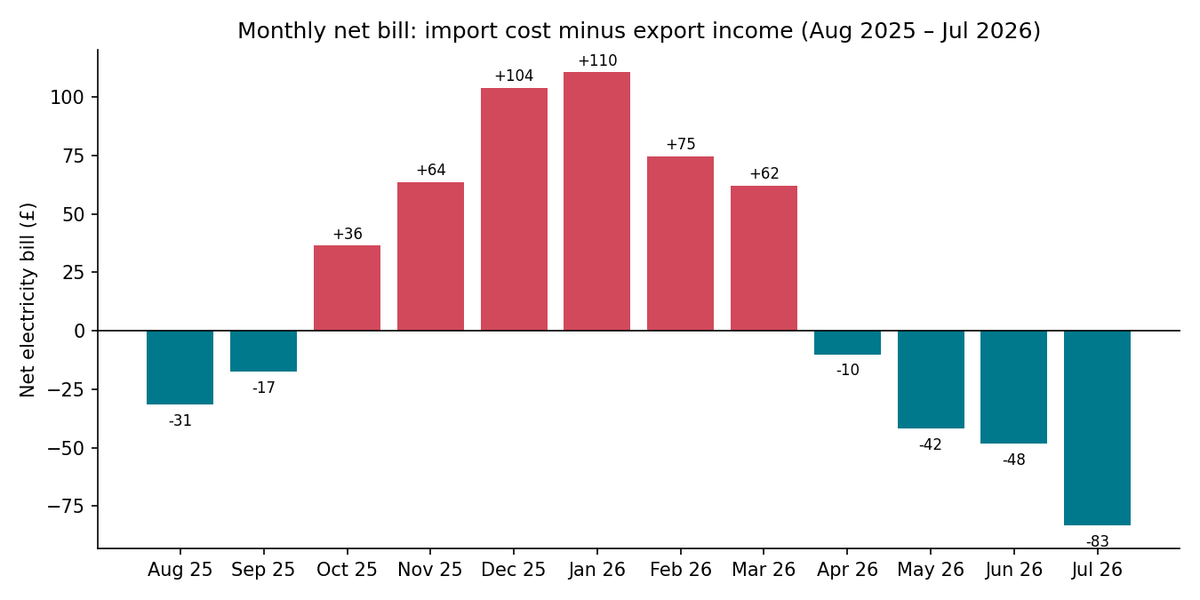
Twelve months of real bills, a heat pump, two solar arrays, a battery, an EV, and every number verified against the smart meter. Including the ones that turned out to be wrong.
Last July, Octopus Energy paid me £83.36. Not a refund. Not a rebate. My electricity bill for the month was minus eighty-three pounds, because the house sold more energy than it bought. It did that while charging a car and running everything else in a four-bed home in Poole.
That was the sixth negative bill of the year. So I pulled every bill from the last twelve months, cross-checked them against a year of smart-meter and Home Assistant data, and worked out what "the race to zero" actually looks like from the inside.
Here's the whole year in one number: £218.34. That's the net cost of every kilowatt-hour this house bought and sold between July 2025 and July 2026: 13,124 kWh in, 6,674 kWh out.
And here's the number that changed how I think about it: £180.35 of that was the standing charge, the fixed daily fee for having a grid connection at all. Strip it out and the energy itself cost £37.99. For the year. Heating, hot water, lights, laundry, and roughly 17,000 miles of driving: about 10p a day.
Put that per unit and it stops sounding like an electricity price at all. The house ran through about 12,100 kWh over the year: grid import plus solar, minus what was sold back. £37.99 across 12,100 kWh is a net effective rate of 0.31p per kilowatt-hour used. Not 31p. Not 3.1p. A third of a penny, roughly a hundredth of what the price cap says a unit of electricity costs.
The race to zero is over. What's left is the connection fee.
How the year actually went
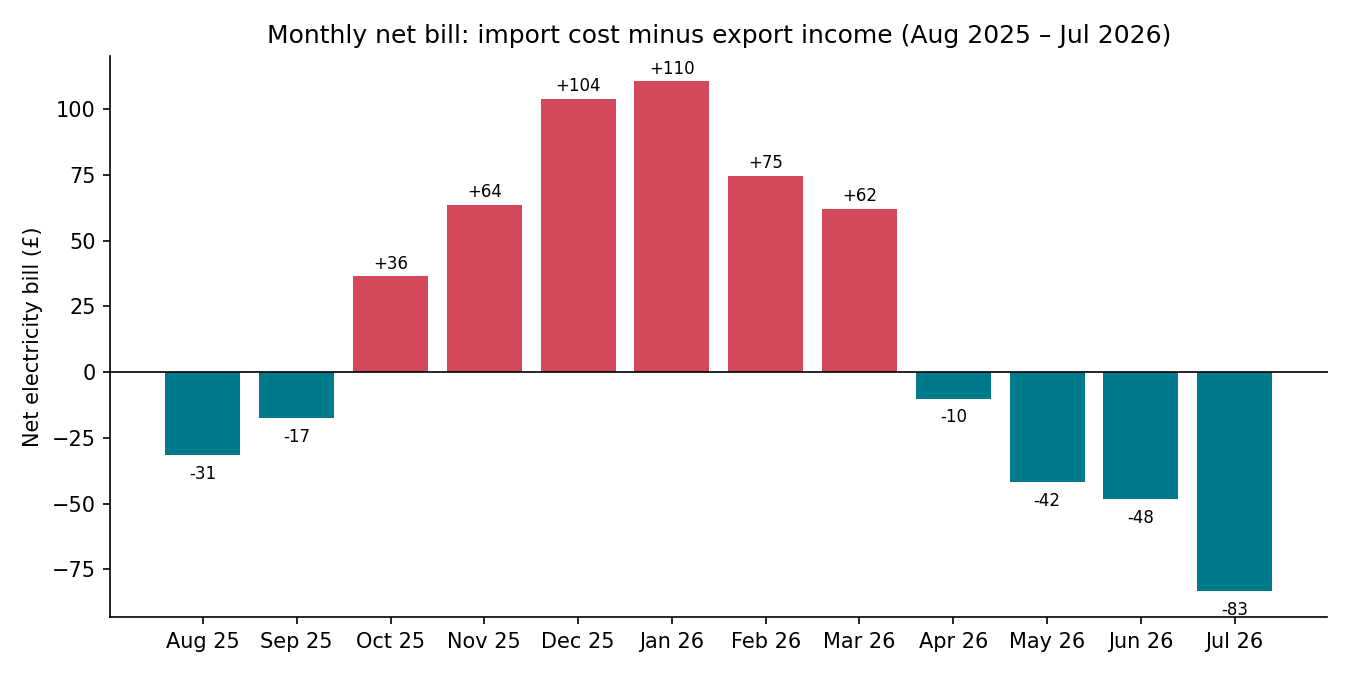
The shape matters more than the total. Six months were negative, six positive, and the swing is entirely seasonal: January cost +£110, July earned −£83. Winter is real: a heat pump in a UK January pulls 1,400 kWh from the grid, and no amount of December sunshine (67 kWh exported, our worst month) changes that.
The trick is that winter and summer aren't playing the same game. Winter electricity is bought cheap; summer electricity is sold dear. Which brings me to the mechanism that makes the whole thing work.
80% by the clock, 99% by the wallet
Everything in this house runs on one idea: never pay the day rate. I'm on Octopus's Intelligent Go tariff: 30.37p/kWh during the day, 6.90p between 23:30 and 05:30, plus whenever the tariff's smart-charging algorithm decides to dispatch the car.
The meter data shows how completely that idea took over:
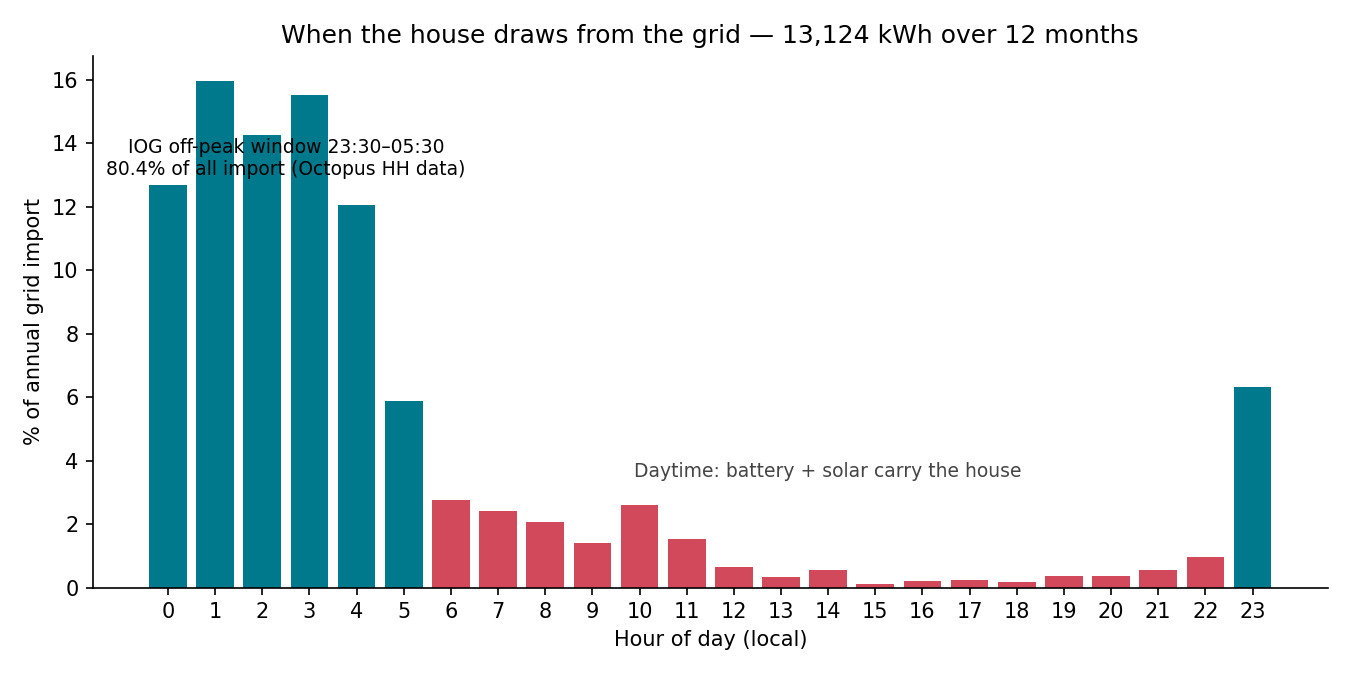
Three-quarters of a year's electricity arrives between midnight and 5am. The battery fills, the car charges, the hot water heats, all while the grid is cheap, windy and quiet. Then the house lives off the battery and the solar until the next fill. No daytime hour takes more than 3% of annual import.
The half-hourly settlement data proves 80.4% of import landed inside the guaranteed off-peak window. But the bills tell you the better number: total import charges, minus the standing charge, come to 7.05p per kWh, barely above the 6.9p night rate. Run the arithmetic backwards and only about 85 kWh of the year's 13,278 was billed at the day rate. Eighty-five. The other ~2,500 kWh drawn outside the window were smart-charge dispatches, billed cheap because the algorithm chose the moment.
So: 80% off-peak by the clock, 99% off-peak by the wallet. The gap between those two numbers is the smart tariff earning its name.
There's a lovely inversion hiding in here. My effective buy price was 7.05p/kWh. My average sell price on Outgoing Octopus was 13.28p/kWh. This house buys low and sells high: it's running a tiny energy arbitrage business with a 5,000 kWh battery-load of cheap night electricity as working capital.
The heat pump, without the brochure numbers
Heat pump scepticism usually survives on the absence of measured data, so here's mine. Over the year the heat pump drew 1,809 kWh of electricity (1,397 for space heating, 412 for hot water), and the space heating delivered 5,555 kWh of heat.
That's a measured seasonal COP of 3.98: every unit of electricity became almost exactly four units of heat.
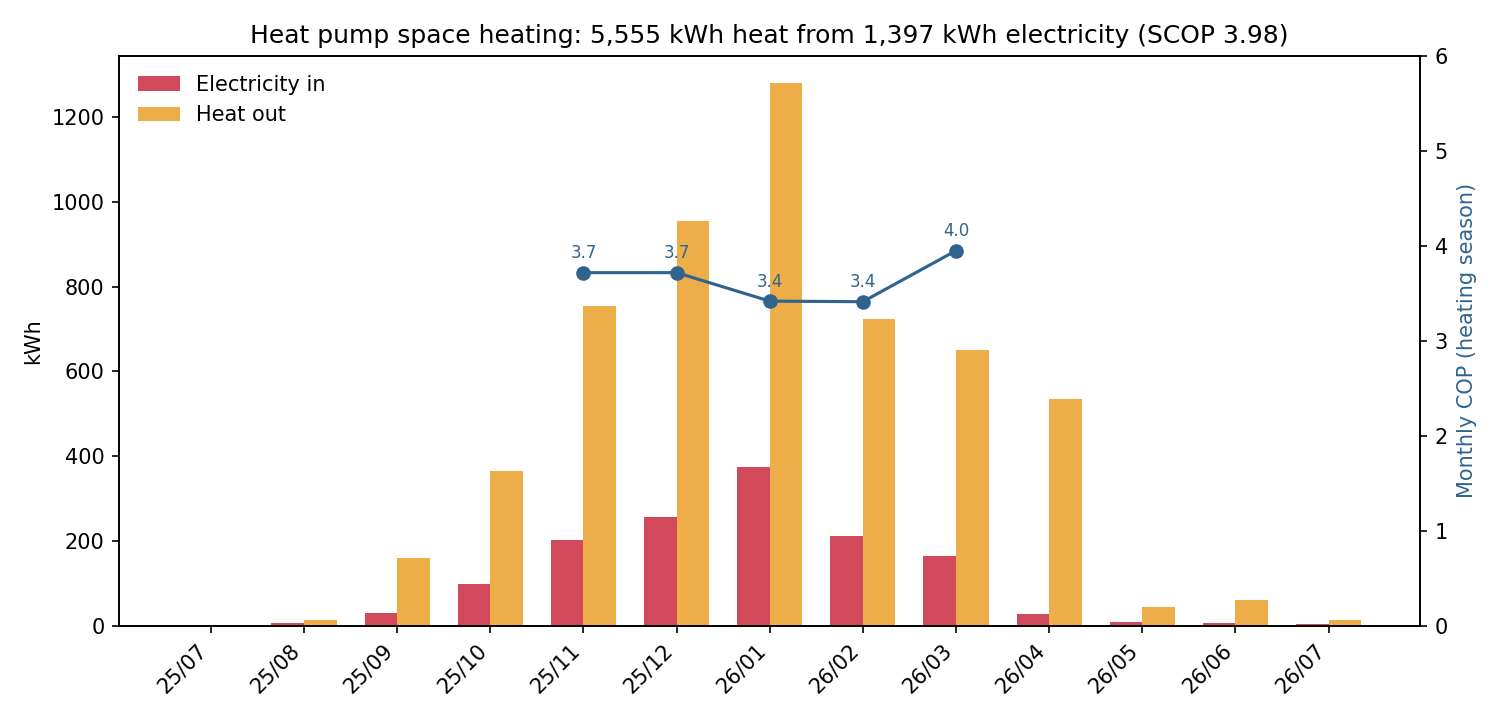
And it didn't fall apart when it got cold. January's monthly average (6.6°C mean outdoor temperature, the coldest of the year) was still 3.4. At night-rate electricity, that's heat at an effective 1.7p per kWh, which is less than a third of what the same heat costs from a gas boiler even before you argue about carbon.
Total heating-and-hot-water electricity bill for the year, at my effective rate: about £128. My gas-boiler neighbours would take that for a winter month.
The car and the home battery are inside these numbers
This is the part people miss when they see a £218 annual bill: it includes the transport. The home charger delivered 4,844 kWh into the EV over the year: call it 17,000 miles at typical efficiency. Almost all of it dispatched into the off-peak window at 6.9p, which works out around 2p a mile. Petrol at 45mpg is roughly 15p a mile; the fuel bill alone for the same driving would have been ~£2,500.
The home battery is in there too: another 5,071 kWh of night-rate electricity went into filling it, and 3,396 kWh came back out to carry the house through the day. That's not a hidden extra: it's inside the same import number, storage losses and all. Which makes the £218 more remarkable, not less: it covers the house, the heat, the car and the battery that makes the whole strategy work.
So a fairer framing of the year isn't "cheap electricity". It's: house + heat + battery + 17,000 miles ≈ £326 all-in (I'm adding back the standing charge and the £9/month heat pump service plan, because honesty).
The numbers I refused to publish
This article nearly contained a much better stat, and it would have been wrong. My Home Assistant dashboard claimed 99.6% of my import was off-peak. Impressive! Except the helper sensor's "peak" counter had silently frozen a year ago, so the ratio was an artefact. The real, settlement-grade figure is the 80.4% above (rescued to ~99% only via the bill arithmetic, which is a different claim with a different footnote).
The audit also killed: a hot-water COP of 55 (broken template; the true figure is boringly plausible), a battery that apparently discharged more than it charged (counter glitch, so no round-trip efficiency claims here), a duplicate EV sensor that would have double-counted 4,750 kWh, and one heroic day where a balcony solar panel allegedly produced 449 kWh (it was a database restore, not a miracle).
I mention this because almost every "look at my amazing solar setup" post you've read is built on home-automation sensors exactly like these, uncross-checked. The numbers in this article survive three independent chains: Octopus's bills, Octopus's half-hourly meter statistics, and the inverter's own CT clamp, which agree with each other to within 1.2%. If a number couldn't be verified, it isn't here.
What "zero" turns out to mean
Add it all up and the destination is stranger than the journey. The race to zero doesn't end at zero. It ends at the standing charge: £180 a year, about 49p a day, for the privilege of the connection that makes the whole arbitrage possible. I wouldn't give it up. The grid is my winter battery, my summer customer, and my price signal.
The kit did the work: solar panels made 5,681 kWh, the battery shifted over 5,000 kWh of cheap night electricity into expensive daytime, and a smart tariff moved 99% of my buying into the cheapest sixth of the day. None of it required behaviour change. Nobody in this house waits until midnight to boil the kettle. The algorithm does the virtue; we just live here.
Next year's race isn't to zero; it's past it. On current trajectory, the export income needs to grow by £218. A little more panel, a little more battery, and the electricity company starts paying the standing charge.
Data: 12 months of Octopus Energy bills (Aug 2025–Jul 2026 billing cycles), cross-verified against Octopus half-hourly settlement statistics and Home Assistant long-term data (44 sensors, independently audited). All prices include VAT. Effective-rate calculations assume the year-end tariff rates held throughout.